

Iterative Scaffold Optimisation in Practice.
Key result: In one design cycle, 9 of 10 novel derivatives reached an IC50 below 6 nM in biochemical assays, at least a 100-fold improvement over the parent, and one compound reached sub-nanomolar potency.
The real bottleneck: lead optimisation
Hit identification is rarely where drug discovery programmes stall. The harder step is lead optimisation: turning a validated chemical series into compounds with the potency, selectivity and ADMET profile a development candidate needs. Conventional programmes get there through successive design–make–test–analyse (DMTA) cycles driven by medicinal chemistry intuition and accumulated structure–activity relationships (SAR). Each cycle typically takes months, and much of the synthesis effort goes to compounds that do not improve on the parent.
Anyo Labs developed the Iterative Scaffold Optimiser (ISSO) to make each cycle more informative, so that fewer cycles are needed.
How ISSO works?
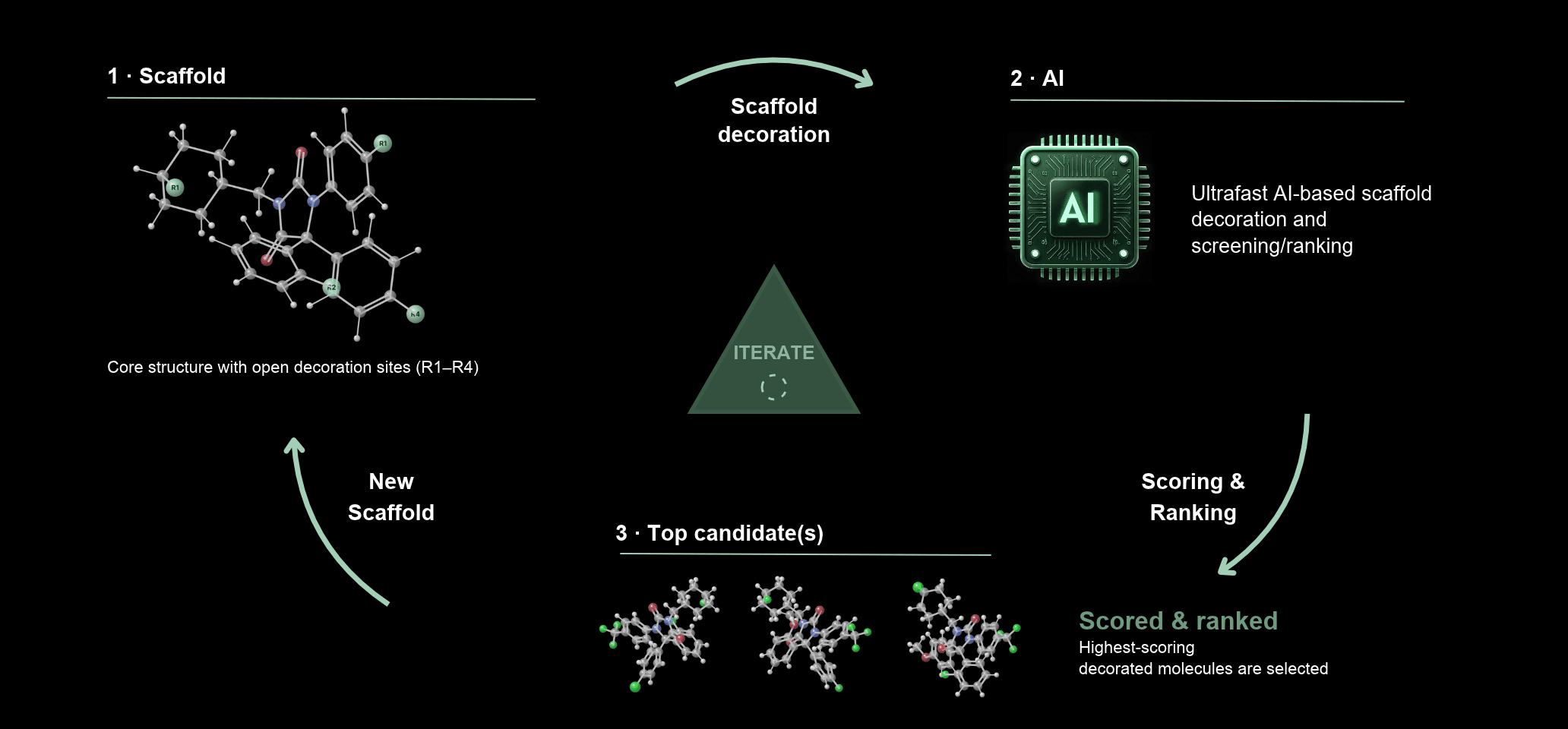
ISSO is a structure-based generative design tool built to optimise existing series rather than discover new chemotypes. It is the analogue-design mode of iGen, Anyo Labs' generative engine: where iGen designs compounds de novo for pockets that commercial catalogues cover poorly, ISSO starts from a series that already works, so no new screen is required. Starting from a parent scaffold and its target structure, it keeps the core binding motif and explores modifications around it, decorating, swapping and growing the scaffold periphery. The derivatives it generates stay synthetically accessible and consistent with the established SAR.
Generation runs on MolAI, a deep-learning autoencoder that represents chemistry in a 512-dimensional latent space at over 99.8% reconstruction accuracy. Moving through a learned space rather than enumerating substitutions by rule is what keeps the output chemically sensible while still reaching modifications a cycle driven by intuition alone would be unlikely to prioritise.
Each cycle generates and scores thousands of derivatives automatically. In an internal study on the SARS-CoV-2 main protease, three successive ISSO cycles generated 2,705, then 1,386 and then 4,619 derivatives, raising predicted affinity from pKd 7.1 to 8.6. Those values are computed rather than measured; what they illustrate is scale. Scoring a library that size in a single pass on one compute node is what allows a final shortlist to be drawn from an exhaustively ranked set rather than from a subset chosen by hand.
Each candidate is then scored for predicted binding using iScore, Anyo Labs' AI-based scoring algorithm, which generalises to protein structures it has not seen before without project-specific retraining (Mahdizadeh & Eriksson, J. Chem. Inf. Model. 2025; Swedish patent SE547814C2). Candidates are filtered on predicted physicochemical and ADMET properties, such as solubility, permeability and known liabilities: iADMET's 14 models run alongside iScore in every cycle rather than as a final filter, so liabilities surface during design instead of two cycles later. Synthetic feasibility is scored in the same loop. The output is a short, ranked set of optimized compounds, each with its predicted profile and estimated synthetic feasibility.
Experimental results from each round feed the next, so later rounds build on measured data rather than predictions alone. Where a conventional programme needs 8–12 DMTA cycles to reach a candidate, ISSO is built to reach one in three to four.
Case study : IRE1α
We worked with Exanoma Therapeutics AB, a company built on research at the University of Gothenburg, on IRE1α, the most conserved sensor of the unfolded protein response (UPR). Through its kinase and endoribonuclease activities, IRE1α drives XBP1 mRNA splicing and adaptive signalling that help tumour cells survive endoplasmic reticulum stress. Glioblastoma and other aggressive tumours rely on this pathway to cope with accumulation of unfolded and misfolded proteins in the ER. That makes IRE1α an attractive but chemically demanding target.
The starting point was an established lead with an IC50 of about 600 nM and a documented development history based on further developments of the 'Z4P' compound [Pelizzari-Raymundo D, Doultsinos D, Pineau R … A novel IRE1 kinase inhibitor for adjuvant glioblastoma treatment. iScience, 2023; 26(5), 106687.]
A series in that position is what ISSO is built for. The parent was potent enough to confirm the binding mode but too weak to progress, and its published development history meant there was real SAR to constrain the generator: a space of modifications already known to matter, rather than an open field. The task was not to find new chemical matter but to search the periphery of a working scaffold more thoroughly than a synthesis-limited cycle can.
Using the parent compound, its SAR and the available structural data, ISSO generated and prioritised a first set of 10 derivatives. We delivered these with their predicted properties whereafter the client had the compounds synthesized and subjected to biochemical testing.
Ten is a deliberately short list. Because affinity, predicted properties and synthetic feasibility are scored together in each cycle, few derivatives clear all three at once, and there is little to gain from ordering the ones that clear only one. The economics of the round follow from that: synthesis and assay budget went to ten compounds rather than the dozens a conventional cycle commits to.
Results
In the first round of testing, nine of the ten novel derivatives had IC50 values below 6 nM, at least a 100-fold improvement over the parent, with the 10th compound showing a 4-fold improvement. One compound reached sub-nanomolar potency and hence a remarkable 500-fold improvement in binding. In lead optimisation, most synthesised analogues fail to improve on the parent, so a 100% success rate, with every compound in the set improving and nine of them by two orders of magnitude, within a single cycle is notable.
The uniformity of that result matters as much as its size. One standout among nine failures would point to luck; a set in which every compound improves points to the ranking having been informative before anything was made. It also puts iScore's generalisation to the test prospectively rather than on a benchmark: IRE1α was a target the model had not been trained on, and no project-specific retraining was done for it.
The sub-nanomolar compound is the clearest argument for the generative step. Its modification was not one the series' documented SAR would have ranked first; it was generated, scored and shortlisted on predicted affinity and properties, and only then made. That is the difference between searching a scaffold's periphery exhaustively and sampling the parts of it precedent recommends.
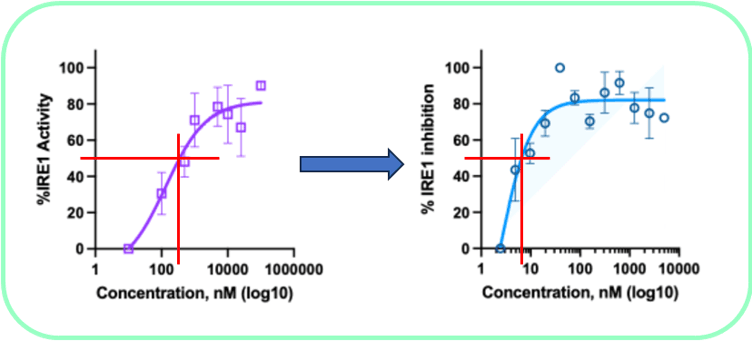
Building on these data, the collaboration has moved into a second ISSO design round to refine the series further, now targeting additional cellular properties. The same workflow applies whenever a series needs to improve on several parameters at once: binding affinity, solubility, permeability and/or the reduction of predicted adverse effects. The second round also closes the loop the method depends on, since the measured IC50 values from round one now constrain the generator, so the next set is designed against data rather than prediction alone.
If you have a series that has plateaued in optimization, we would be glad to discuss how ISSO could help. info@anyolabs.com